
Bangladesh's interim government chief Professor Muhammad Yunus is considering resigning after political parties failed to reach a common ground, according to the National Citizen Party (NCP) chief. Yunus, appointed after a student-led uprising toppled the previous government, expressed concerns about his ability to function in the current political climate.
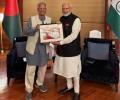
In his first meeting with Bangladesh Chief Adviser Muhammad Yunus, Prime Minister Narendra Modi on Friday flagged concerns over the attacks on minorities, including Hindus and conveyed that any rhetoric that vitiated the environment was best avoided.

'The policies announced by his administration are implemented faster.'
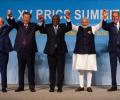
Dar also said Pakistan views Russia as an important player in the West, South and Central Asia, and strengthening mutually beneficial cooperation with Russia remains an important priority for Pakistan's foreign policy.

Facing criticism from the government over the central bank prioritising inflation over growth, the new RBI Governor Sanjay Malhotra on Monday said that prospects of the Indian economy are expected to improve on the back of high consumer and business confidence in 2025. "As we strive to preserve financial stability to support a higher growth path for the Indian economy, our focus remains steadfast on maintaining stability of financial institutions and, more broadly, systemic stability," Malhotra said in foreword to the Financial Stability Report.

Shigeru Ishiba is expected to prioritise strengthening Japan's military capabilities and fostering deeper international partnerships, particularly with India, with whom Japan shares significant strategic interests, explains Dr Rajaram Panda.

'India today feels enough is enough and we need to teach Pakistan a lesson.' 'Unless compelled, Mr Modi will think 10 times before taking the extreme step.'

Existing trade deals, especially the 2009 pact with the Asean bloc, have been panned by the Centre for not boosting exports but flooding the domestic market with cheap imports. Subsequently, New Delhi has called for reviewing FTAs with Japan and South Korea. Going by that, a trade deal with the US is unlikely to be beneficial, say experts.
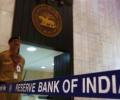
The Reserve Bank of India hiked key interest rates by 0.25 per cent each in the last two reviews to tame inflation.
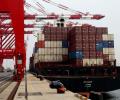
Imports too declined by 16.31 per cent to $37.39 billion.

'Disengagement is merely the first step in a lengthy process of arriving at a new normal along the LAC in Eastern Ladakh and the entire land boundary.' 'The Indian government should insist on the restoration of the status quo ante in Eastern Ladakh.'

At the 9th review of the US trade policy regime, many members -- China, Norway, Thailand, the European Union, among others -- sharply criticised Washington for not adopting WTO-consistent policies in several areas.

The Lok Sabha elections in 2024 are not a consideration when it comes to monetary policymaking, said Reserve Bank of India governor Shaktikanta Das to underscore the central bank's commitment to controlling inflation. "It's not possible for me to comment what we do in the next MPC (Monetary Policy Committee), but one thing I can tell and I would like to make it very clear-that the fact of elections coming up in 2024 is not a factor at all so far as monetary policymaking is concerned. "Monetary policymaking is for checking (and) controlling inflation," Das said at the Business Standard, BFSI Insight Summit.
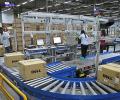
A task force set up by the Ministry of Electronics and Information Technology (Meity) for transforming India into an "electronic and semiconductor products" nation is on the verge of finalising its report, which is likely to recommend an allocation of Rs 44,000 crore between 2024 and 2030 to support homegrown companies in their quest to develop products and build global brands. The task force's recommendations include significant incentives: Rs 15,000 crore dedicated to electronic products (systems), Rs 11,000 crore for semiconductor products, and Rs 18,000 crore for various other incentives such as talent development, common infrastructure, logistics, and technology & IP (intellectual property) acquisition, a member of the panel revealed.

President Kovind, who arrived in Dhaka earlier in the day on his maiden State visit at the invitation of his counterpart M Abdul Hamid to attend the golden jubilee celebrations of Bangladesh's independence from Pakistan in 1971, held delegation-level talks with him which was followed by a banquet.

India's gold and silver imports from its free trade agreement (FTA) partner UAE have skyrocketed 210 per cent to $10.7 billion in 2023-24 and there is a need to potentially revise the concessional customs duty rates under the pact to mitigate the arbitrage driving this surge, a report said on Monday. Economic think tank Global Trade Research Initiative (GTRI) said this sharp rise in gold and silver imports is primarily driven by import duty concessions granted by India to the UAE under the India-UAE Comprehensive Economic Partnership Agreement (CEPA).

Demonetisation, Donald Trump's surprise victory in the US presidential elections, and the fear that US Fed may hike rates in the upcoming policy review in December have dented market sentiments, report Puneet Wadhwa & Deepak Korgaonkar.
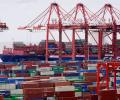
Exports contracted by 2.6 per cent to $34.47 billion in September even as the country's merchandise trade deficit narrows to $19.37 billion during the month under review, according to the government data released on Friday. Easing commodity prices helped in cutting down the country's import bill by 15 per cent to $53.84 billion in September, the 10th consecutive month of decline. During April-September this fiscal, exports contracted by 8.77 per cent to $211.4 billion.

The government announced several incentives in the five-year Foreign Trade Policy.

Mint Road, on December 21, 2023, flagged the role of self-regulatory organisations (SROs) in strengthening the compliance culture in regulated entities (REs) and providing a consultative platform for policymaking. It also decided to issue an omnibus framework for SROs.

RBI's interest rate decision, macroeconomic data, global trends and trading activity of foreign investors are the crucial factors to drive equity markets in a holiday-shortened week ahead, analysts said. Markets would remain closed on Monday for Gandhi Jayanti. "While global cues will continue to dictate trends in local markets, focus will shift to RBI's monetary policy announcement on Friday. "Although the market is expecting a status quo on interest rates, global concerns like rising US dollar index and bond yields coupled with surging crude oil prices continue to weigh on investors' minds.

Events to keep an eye out for...

As COVID-19 infections spike in the country resulting in restrictions in various states and impacting the fragile recovery, many economists are expecting RBI to delay the policy normalisation move, which is expected in the February review. The country has reported a single-day rise of 58,097 new Covid-19 cases as of Wednesday morning--the highest in around 199 days -- of which 2,135 are Omicron cases and later in the day, the first confirmed Omicron-related death has also been reported. Maharashtra recorded the maximum number of 653 Omicron cases followed by Delhi at 464, Kerala 185, Rajasthan 174, Gujarat 154 and Tamil Nadu 121 cases, taking the total tally of cases to 3,50,18,358.

After heavy selling in the past two months, foreign investors have staged a strong comeback to Indian equities with a net investment of Rs 24,454 crore in the first week of December amid stabilising global conditions and expectations of potential US Federal Reserve rate cuts. This revival follows significant outflows in the preceding months, with foreign portfolio investors (FPIs) pulling out a net Rs 21,612 crore in November and a massive Rs 94,017 crore in October - the worst monthly outflow on record.
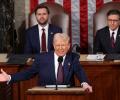
'Trump's desire to withdraw the US from some arenas on the global stage will result in ceding space to China.'

Due to the huge pile-up of visa applications, the US consular officers in the neighbouring country are now adjudicating Indian visa applications where interview requirements have been waived.

It will be the second Budget of the Modi 3.0 government and eighth straight Budget for Nirmala Sitharaman, rare in Indian polity.

Among the Sensex stocks, Larsen & Toubro rose the most by 3.96 per cent after the company announced a major project win in the Middle East. HDFC, HDFC Bank, Sun Pharma, ITC, HUL, Titan, TCS, HCL Tech, Asian Paints, Bajaj Finance, Infosys and Tata Steel were among the major gainers.
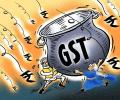
Gross GST collection grew 9 per cent to over Rs 1.87 lakh crore in October on higher revenues from domestic transactions. The Central GST collection stood at Rs 33,821 crore, State GST at Rs 41,864 crore, Integrated IGST at Rs 99,111 crore and cess at Rs 12,550 crore.

External Affairs Minister S Jaishankar on Sunday concluded a crucial visit to Male, assuring the country's top leadership that the Maldives remains an important partner of India in maintaining peace, stability and prosperity in the Indian Ocean region.

The proposed policy is increasingly becoming an item of negotiation, as the US pushes hard to change India's stance.

To strengthen corporate governance practices and disclosure requirements, Sebi has notified new rules, including that top 1,000 listed firms will have to formulate a dividend distribution policy. The regulator has also put in place a framework in relation to applicability, constitution and role of the Risk Management Committee (RMC) and eased norms for re-classification of a promoter as a public shareholder, according to a notification dated May 5. In addition, the regulator has asked listed firms to make available audio and video recordings of analyst and investor meets on their websites as well as stock exchanges within 24 hours or before the next trading day and also notified rules regarding Business Responsibility and Sustainability Report (BSSR).

The finance ministry has cautioned that global and regional uncertainties and domestic disruptions may keep inflationary pressures elevated in the coming months, warranting "greater vigilance" by the government and the Reserve Bank of India (RBI). "Russia's decision to terminate the Black Sea grain deal, along with dry conditions in major wheat-growing areas, caused a price spike in cereals. Domestic factors like white fly disease and an uneven distribution of monsoon exerted pressure on vegetable prices in India," the ministry said in its latest Monthly Economic Report for July, released on Tuesday. However, the report maintained, the recent price surge in certain food items "is expected to be transitory". "Tomato prices are likely to decline with the arrival of fresh stocks by the end of August or early September.

In the Union Budget for Financial Year 2023-24 (FY24), Finance Minister Nirmala Sitharaman had held forth on the need for better governance and investor protection in the banking sector. She had proposed certain amendments to the Reserve Bank of India Act (RBI Act), 1934; the Banking Regulation Act (BR Act), 1949; and the Banking Companies (Acquisition and Transfer of Undertakings) Act, 1970.

RBI's interest rate decision, macroeconomic data and global trends would dictate terms in the equity market in a holiday-shortened week, analysts said. Besides, the focus will also be on foreign portfolio investors' trading activity, they added. Equity markets will remain closed on Tuesday for 'Mahavir Jayanti' and on Friday on account of 'Good Friday'.

The battered rupee is likely to trade in the range of 54-56 against dollar in the current fiscal with a possibility of widening of this band depending on strengthening of the US unit, Citi Research said.

The policy proposes a single-window platform for facilitation of the Indian software product industry, to help fast-track legal and regulatory issues over import and export, as well as setting up and winding up enterprises.

The council resisted intense pressure from the powerful manufacturing, pharma and other trade lobbies that have urged the Obama administration to enact punitive measures against India for a laundry list of alleged intellectual property and patent violations.

Regularly monitor your account for any suspicious activity. Keep your devices updated with the latest security patches to prevent vulnerabilities. Ensure the physical wallet you use is stored securely to avoid loss or theft.

Novice investors must understand that volatility is an inherent part of equity markets and learn to navigate through such phases.
